

Don't let Ben Stiller dunk on Lumen
Boring and confusing is good


Large, multi-generational corporations tend to be boring — like Telecom.
But are they bad? Nefarious? Evil masterminds plotting world domination between quarterly earnings calls?
Maybe Ben Stiller should have renamed the big bad company in Severance to Palandeer, not Lumon.
(Maybe he lost a bundle in Lumen during the 2000 market crash)
Not sure. Either way, can’t wait for Season Three.
What I do know is this: instead of running away from a boring company, maybe we should run toward it, just not when the value investors are already running in circles yelling “Book Value!”
Take Southeastern Asset Management, one of those Buffett-style long-term investors. At one point, they owned a hefty stake in Lumen. They analyzed the numbers, the fundamentals, the liquidation value — all the classic deep-value stuff. Then, after enough red ink to fill the Nile River, they packed up and moved on.
Southeastern saw reality; Lumen saw the future. Their timelines didn’t line up: Southeastern was thinking in years, the other in multiples of decades.
Then along came Alex Karp of Palantir, the philosopher-king of data analytics, sliding into the picture just as Lumen’s stock cratered to around $4. He didn’t see a broken company; he saw railroads in waiting.
Palantir’s smart brain needs a superfast road to send and receive information.
Lumen’s network provides those roads, bridges, and speed limits.
Together, they help businesses:
Use AI closer to where data actually happens (factories, cities, airports).
Make smarter choices faster (before something breaks).
Keep everything safe and private (because no one likes a data leak).
They say the AI boom is as transformative as the railroad buildout of the last century, and if that’s true, then fiber optics is the new rails.
That was the headline that caught my eye last week to research a little bit:
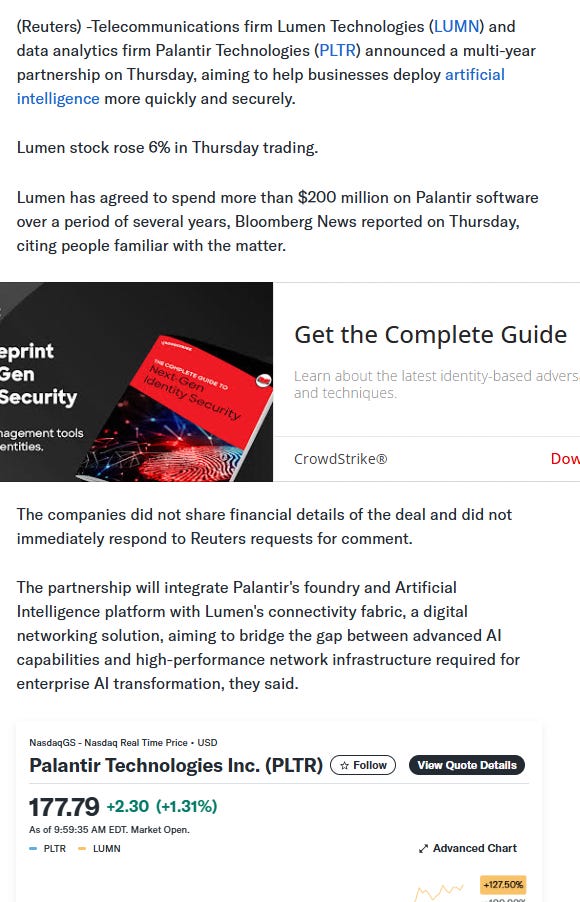
From what I understand, AI needs rails, and Lumen owns the track.
Lumen’s digital tracks stretch from Silicon Valley to New York, London to Singapore, which, I guess, is about 400,000 miles of buried steel and glass.
They don’t move passengers; they move data trains.
Every day, Lumen’s network carries:
Cloud providers (AWS, Google)
Government agencies
AI labs
Hospitals, factories, and stock exchanges
Just like Union Pacific or B&O charged tolls for using their tracks,
Lumen charges digital tolls — bandwidth, fiber leases, and edge access — on the new information superhighway.
We live in a world obsessed with flashy tech stories, but the quiet giants, “boring” infrastructure firms with $15 billion dollars of debt, are the ones laying the tracks for the next century.
So maybe, just maybe, boring is beautiful; especially when it powers the brain of AI. And allows a debt-laden company to be cash flow positive in a trillion-dollar ecosystem.
Didn't expect this take on the subject, but I love the idea of 'AI closer to where data actually happens.' Vry insightful, makes a lot of sens for efficiency.