


Today’s note is about a day at the end of the week that is special and argues is essential for anyone looking for more out of life than materiality, and a movie recommendation to go along with it.
But it also reflects a historical period filled with misinformation, as it is now. And bring to your attention that all that glimmers isn’t gold.
And, at the end of the day, to have a little faith. The idea of a country run by the people, and of the people, not by a King, and not be commiseriat, is truly a blessing for all of us.
There was a time I was at NYU, studying film. I dreamed every day of making the great American picture. I had talent, drive, and great ideas (some even lifted by some Hollywood greats).
But what I didn’t have was the social infrastructure to go with it.
The normal way of socializing through smoking, drinking, and parties was something I didn’t partake in. And Friday evenings, a great time to be alive in New York City, I was not out clubbing with my fellow artists.
And when I did, they didn’t want to talk about movies and cinema, but had a good time and much more memorable pleasures.
John LeFevre puts it best as he tends to:


A few drinks build bonds that kale smoothies never will.
There was a real estate developer who wanted to become a great man in the world, but first had to claw his way out of bankruptcy.
He was anything but a private individual. He had luck, yes. But more importantly, he had friends who understood the power of a room, a handshake, a dinner. Networking wasn’t a liability for him. It was oxygen. And his creditors understood that…

That man is now President of the United States.
And this week, our paths cross.
For the first time in 250 years, at a most opportune time, a sitting President has issued a proclamation that most Americans have never heard of nor celebrate: Sabbath.
From sundown May 15 to nightfall May 16, Trump called on friends, families, and communities of all backgrounds to come together in gratitude, recognizing the sacred Jewish tradition of setting aside time for rest, reflection, and gratitude to the Almighty.
He invoked Washington’s 1790 letter to the Hebrew Congregation at Newport, “none to make him afraid.”
https://www.whitehouse.gov/presidential-actions/2026/05/jewish-american-heritage-month-2026/

You also probably missed that today, the mighty Arab countries lost their control over Jerusalem. In just six days.
Before that war, the headlines screamed that Israel was finished. Here is a headline from before the war; it may remind you of recent events.
(UAR is Egypt)
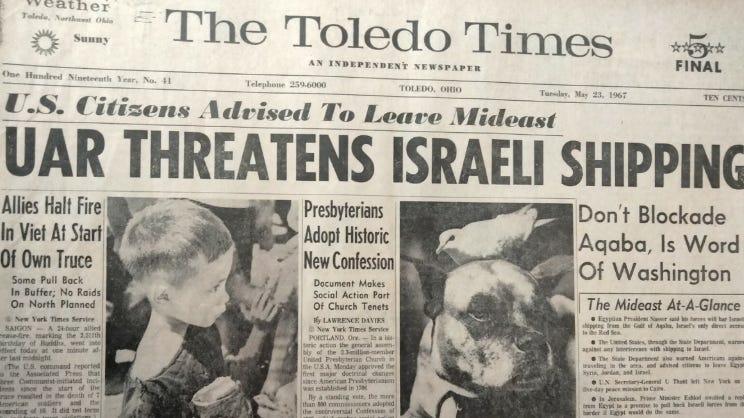
Here is the headline a few weeks later. Of course, our current state of affairs would call that into question.
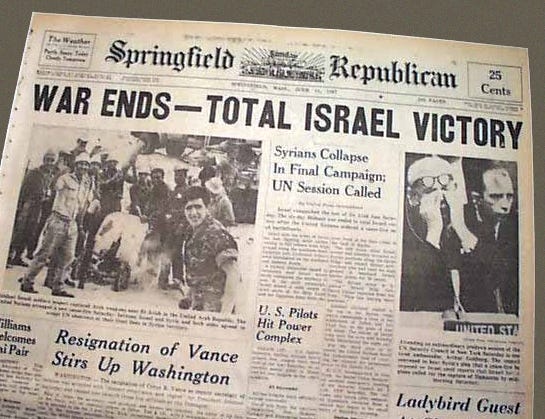
(Even back then, there was a Vance, the more things change…)
Today, Jerusalem is, for some, a city of conflict (my AI thought that, which I am about to correct).
The opposite is true. It, in fact, follows what Psalm 122 calls “a city uniting all.”
It is the one city on earth where the holiest sites of Judaism, Christianity, and Islam stand within walking distance of each other and where all three faiths may worship.
Not perfectly. Not without tension. But the access exists.
Not before the 6-day war.

I know this firsthand, and the reporters misrepresenting the facts on the ground.
Once, I was sitting at a bar in Jerusalem, an actual bar, cold beer, people laughing (I do socializing during the week and fewer deadlines than college), and there was an entire crew of CNN reporters at the next table. Not with bulletproof vests but Tommy Bahamas.
I struck up a conversation and asked them the obvious question: " Why don’t you report this?
The happiness. The joy.
They walked away, avoiding any conversation.
As Method Man (and we’ll revisit him later) says:
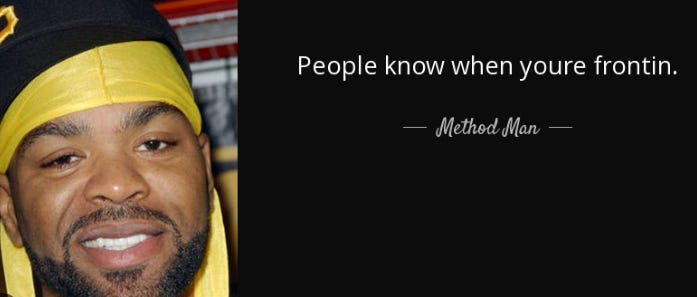
That is the Jerusalem story nobody tells.
The conflict in Israel is real (play on words?).
But so is the bar.
So is the laughter.
So is the fact that the city is still standing, still open, still visited by millions who leave changed by it.
That is nothing. That is, in historical terms, almost miraculous.
And…to appreciate what that means, you need time to reflect. Which brings us back to Sabbath.
Charlie Kirk was no rabbi. He was a Conservative Christian who learned the Jewish Sabbath from his friendship with Dennis Prager and then wrote a book about it.
His final book was completed weeks before he was assassinated in September 2025. His last message to the world.
Stop, in the Name of God begins with his simple declaration: “I desire to bring all humanity back to God’s design to rest for an entire day.”
All humanity. Not just Jews. Not just Christians.
Kirk had initially resisted. “I have to raise $50 million a year and do three hours of radio a day,” he told his pastor. “I will honor God by working harder, not by resting for a day.”
Then he went back to his hotel room and looked up every Bible verse that mentioned the Sabbath. He never looked back.
“Every Friday night, I keep a Jewish Sabbath,” he said at a Turning Point event in January 2025. “I turn off my phone from Friday night to Saturday night. The world cannot reach me, and I get nothing from the world. It will bless you infinitely.”
“We live in a world of fractured minds, anxious hearts, and endless motion. But Sabbath is our rebellion. Our resistance. Our return. It is the declaration that we are not slaves, not to Egypt, not to Pharaoh, and not to Silicon Valley.
We are a free people. And free people rest.”
And it’s not just him. The wealthiest man that ever existed (I think), John D. Rockefeller, said it best:
“He who works all day has no time to make money.”
He also said: “I know of nothing more despicable and pathetic than a man who devotes all the hours of the waking day to the making of money for money’s sake.”
Of course, the reality is that, monetarily, most people just don’t see it that way, and yet at some point, we change what is valuable.
My father, as he got older, tried to step back from the seven-day grind. His competitors didn’t. They succeeded more on paper. I watched that happen. It stayed with me.
To succeed in America, you have to work and work hard. That is not in dispute. But the seven-day work week isn’t an ambition.
The richest man in American history knew the difference.
And if you think the seven-day week with one day of rest is merely custom, something any determined regime could simply overwrite, history has a sharp answer for you.
Kirk covers this in his book, and the record is unambiguous. In 1793, the French Revolution abolished the seven-day week entirely, replacing it with a ten-day cycle called the décade. The logic was clean: longer work stretches, more productivity, and the Catholic Church, whose entire social architecture rested on Sunday, was broken.
Workers now labored nine days before a rest. Church attendance was forbidden. The experiment was enormously unpopular (duh AI), and Napoleon abolished it entirely by 1806. Just for that, he was a great emperor.
Revolutionary rationalism cannot outlast the rhythms built into human beings.
The Soviets tried next. In 1929, Stalin introduced the nepreryvka, the “continuous working week”, a five-day cycle with staggered days off, color-coded so that no two family members rested on the same day.
The stated goal was maximum factory output. The real goal was the same as France’s: to eliminate the shared sacred day and, by extension, the community that forms around it.
The Nazis did not abolish the week. They tried something subtler and in some ways more insidious: they colonized it. Sunday became a vehicle for state propaganda and organized ideological leisure, hollowed of its sacred content and refilled with the regime’s.
Even Ozzy Osbourne knew it. Black Sabbath didn’t name themselves after a day of rest by accident, but named themselves after the thing that terrified the comfortable and the powerful.
The Sabbath, holy or unholy, has always been the most subversive day of the week.
Kind of reminds me of the COVID experiment and its ill-kept mission creep.
Again, three ideological systems,
revolutionary, communist, and fascist,
each took a run at the calendar.
Each was forced to retreat. There is something in the seven-day structure that does not bend to political will. Perhaps by chance.
I am not sure the distinction matters. What matters is that it did not break.
Now there is a film that makes this case better than any sermon could and funnier than anything I could have written myself (I am envious).
Bad Shabbos, directed by Daniel Robbins, a fellow NYU alum and Tribeca Film Festival Audience Award winner who deserved every bit of it, starring Kyra Sedgwick and Method Man.
Yes, Method Man. Which alone earns your two hours.
The premise is simple: an interfaith couple is about to have their parents meet for the first time over a Shabbat dinner on the Upper West Side when an accidental death gets in the way.
A kind of Four Weddings and a Funeral concept, but with Sabbath playing center stage.
Every single character except Method Man has a problem they cannot solve, a dilemma they cannot escape, a version of themselves they cannot face.
The comedy comes from the collision of ordinary human dysfunction with the one day that demands you stop. Shabbat doesn’t care about your unresolved issues. It shows up anyway.
Method Man is the only one who came prepared.
Everyone else is Odysseus on their journey (you know the Greek poem in the news over whether what Christopher Nolan did is sacrilegious).
Which brings me to the real point.
We are a culture obsessed with the long journey of self-discovery. Odysseus sailed for twenty years to get back to who he was. And after all that: the sirens, the cyclops, the gods playing games with his life we still can’t agree on what the story means.
Every generation gets a new translator.
A new cast. A new rewrite with a Feminist translator. The Coen Brothers reset him in the Depression-era South.
Someone else will come along and make him something else entirely. A lifetime of wandering, and other people still get to decide what you found.
The Sabbath is the opposite of that.
You don’t travel for twenty years to find yourself. You sit down on Friday night with the people you love, and you find yourself there (and guests we need those too).
Same table. Same candles. Same faces. Every single week. No sirens. No translator. No casting change. The reset is built into the calendar. The journey lasts one week, and it always ends at home.
That is what the movie understands and what makes it funny. The characters running from themselves aren’t villains. They are just people who forgot to stop.
Method Man, as the doorman with all the answers, and possibly Angel, remind them.
You may be Jewish (probably not). You may not observe a single religious practice in your life. None of that matters. Put the phone down on Friday night. Sit with the people you love. Eat something and be grateful.
That is the whole instruction. Kirk did it. Rockefeller understood it. A sitting President just proclaimed it.
And a very funny movie on Netflix and Amazon Prime just made it undeniable.
Watch Bad Shabbos. If you don’t love it, I’ll give you a free subscription.
Good Shabbos. Make it a reflective weekend,
Eric