

I like Big Bots and I cannot Lie
The moment I realized the future had already arrived

When providing support and services online, you cannot hire enough people to do the job required and any app to give you an edge, “just sign me up.”
AI has been around much longer than people know but the word was not the catch-phrase it is now.
In 2013, I think, I fell in love with automated customer support long before it was something people bragged about using
Back then, customer support was still treated like a human endurance test Tickets piled up Agents repeated themselves Customers got angrier the longer the wait times became, which somehow justified making them wait even longer
Then I ran into Nanorep
Nanorep didn’t announce itself as the future It didn’t try to sound intelligent It just answered questions Real questions, written the way people actually type when they are annoyed and trying to get something fixed
That was the first shock
The second shock was that it remembered Every time a human answered a question, the system quietly filed it away and reused it the next time the same issue appeared Support didn’t just get faster It got less repetitive
That distinction matters more than it sounds
Anyone can automate a script Automating boredom is harder Nanorep did that, and it did it early
I used it briefly Long enough to understand that this wasn’t a toy Also long enough to understand why I couldn’t quite justify paying the monthly fee
It was expensive Not in a scammy way In an infrastructure way
The pricing made sense if you already had scale If you were early, experimenting, or still figuring out your workflows, it felt like paying tomorrow’s bill with today’s budget That doesn’t make the bill wrong It just means the timing is uncomfortable
Some companies pushed through anyway Once support volume hit a certain level, the math stopped being philosophical Human labor flattened The machine kept improving Suddenly the product paid for itself by quietly staying out of the way
That’s usually when a bigger fish shows up
Nanorep followed the familiar arc Bigger clients Deeper integrations More polish Eventually, in 2017, it was acquired by LogMeIn and folded into a larger customer engagement platform Later, that technology moved again, becoming part of Genesys
Started with about $2 million and Sold for $45 million
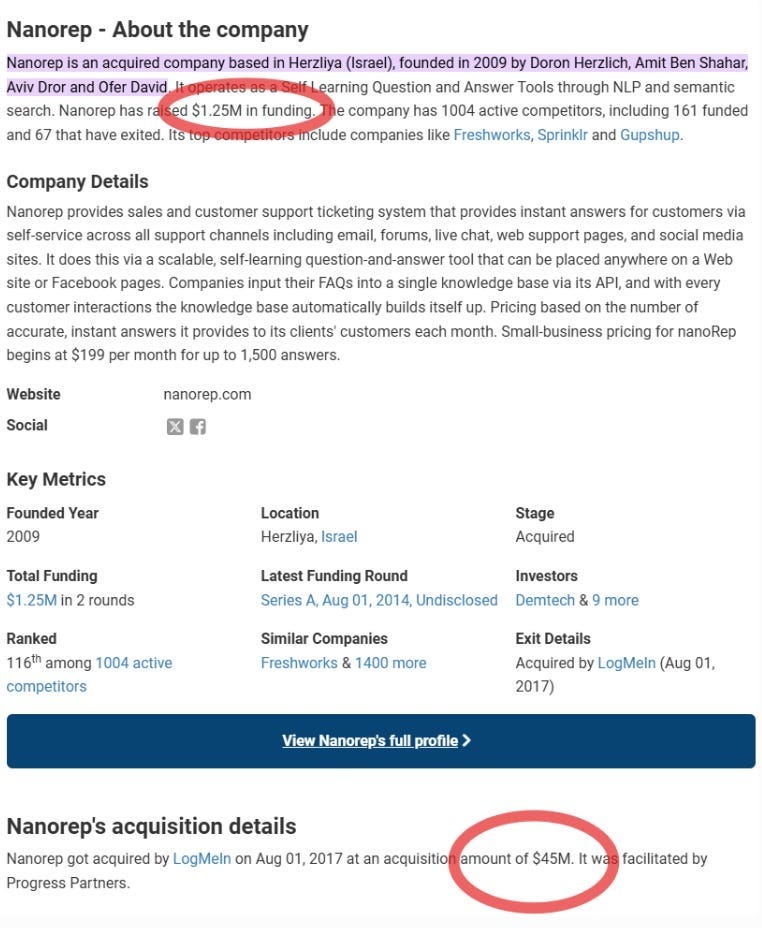
The name disappeared The logic didn’t
Today, everyone claims to be using AI for customer support Chatbots are everywhere So are assistants, workflows, and “intelligent” systems that all promise the same thing Nanorep was already doing years earlier
Automate the repeatable Let humans handle the strange cases Reduce friction without announcing that you’re doing it
So what’s new?
That’s the part people keep missing about AI right now The future doesn’t arrive affordably It arrives working The price comes down later, once the people who needed it most have already paid for it
I didn’t misunderstand Nanorep I just hadn’t yet seen enough cycles to recognize the pattern fully
Now I have
AI doesn’t replace everything at once It starts by removing repetition Then it quietly becomes infrastructure Eventually, you forget what life was like before it showed up
Nanorep was that moment for me
This isn’t new It’s just finally cheap enough for everyone else to notice
I’m sharing this now because we are at the same stage with AI that Nanorep occupied years ago The technology works It is still expensive in the places that matter And it is already shaping decisions long before most people feel comfortable talking about it
I’ve been testing online software for roughly twenty years Most products promise improvement Very few actually change behavior Nanorep did, which is why it stayed with me even after I stopped using it
That experience is what I’m offering here Not access to tools, and not a catalog of recommendations, but a way of thinking about when technology has crossed the line from interesting to inevitable
For five dollars a month, I share how I personally use AI to clarify real decisions as they come up Not demos Not prompts pulled from a library Actual questions I ask to reduce noise and focus attention
This week’s example is email Not how to respond faster or write better replies, but how to decide which messages deserve thought at all What requires judgment What can safely wait What looks urgent but isn’t
The value isn’t the answer It’s learning how to recognize the question
Nanorep taught me that the future doesn’t arrive loudly It arrives working By the time it feels obvious, the transition has already happened
This is about learning to see that moment earlier
Seize the Day
Eric
