


A quick note before we start: I use AI and software every day to do things that would otherwise take me hours: research, compare documents, test ideas, study markets and occasionally disappear down a Mario Puzo rabbit hole.
I’m also building my own time-saving software and making it available for readers to try. If you enjoy the way I research and think through things here, a paid subscription is $5 a month and gives you access to the tools I’m building, along with my regular research and writing.
Subscribe and try the software for yourself.
Now, back to Mario Puzo.
There’s an old saying I used in my essay to get into NYU, and I’ve never forgotten it:
“If it ain’t on the page, it ain’t on the stage.”
Remember that whenever you consume anything creative.
Before Brando could become Don Corleone, somebody had to create Don Corleone.
Before Pacino could close that door on Kay, somebody had to decide that the door should close.
Before Coppola could point the camera anywhere, somebody had to build the world worth pointing it at.
And yet, somehow, we tend to forget the writers.
Did you know Mario Puzo wrote The Godfather and also worked on Superman?
Think about that resume.
Puzo created Vito Corleone and Michael Corleone then he co-wrote the screenplay with Francis Ford Coppola.
They won an Oscar.
Then they co-wrote The Godfather Part II.
They won another Oscar.
And Puzo later received story and screenplay credit on Richard Donner’s Superman.
The Mafia epic and the superhero blockbuster.
Not bad.
But when we remember these movies, most of the fame goes to Francis Ford Coppola, Marlon Brando, Al Pacino and Christopher Reeve rather than the guy who first had to put these worlds on the page.
So I tried an experiment.
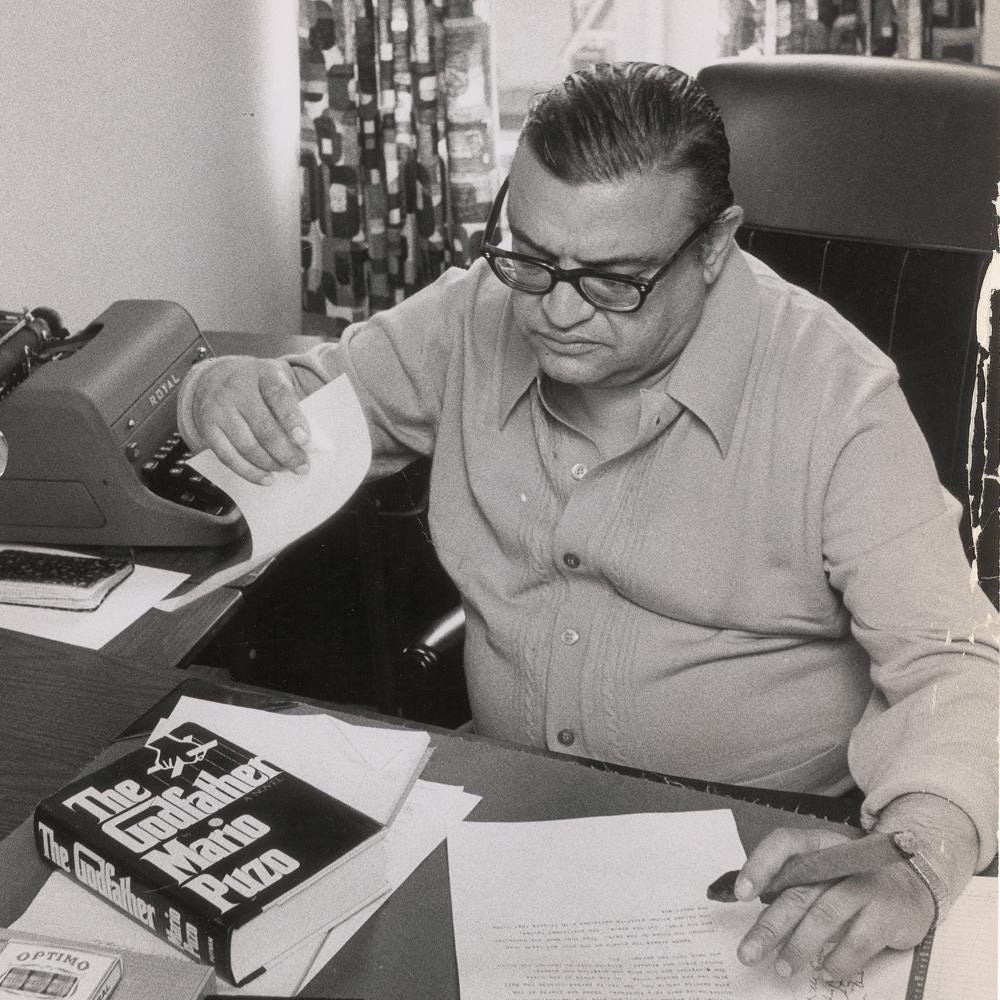
A number of people I spoke with had never read The Godfather. Others had read it decades ago. And realistically, most people aren’t going to stop what they’re doing this weekend to read a 400-plus-page novel just because I became temporarily obsessed with Mario Puzo.
So I put the original novel and the screenplay into NotebookLM and asked it to compare them.
What Stayed?
Essentially everything. The story was meant for an epic and so it was made thus. Anything essential that was missing was added in the 2nd film.
Which is why Coppola’s imprint was on the third film, but not Puzo. I italicized the probable logic of why the film made the choices it did.
The Wedding
Both versions begin at Connie Corleone’s wedding.
And we discover that favors—not money alone—are the currency of his world.
Hollywood and the Horse
Tom Hagen travels to Hollywood to persuade producer Jack Woltz to give Johnny Fontane a role.
You don’t exactly need another 40 pages explaining the Corleone negotiating strategy after that.
Sollozzo, the Hospital and Michael’s Transformation
Michael, previously the son determined to remain outside the family business, finds himself protecting his father at the hospital.
Michael walks into the restaurant as Vito Corleone’s son.
Sicily and Sonny
Michael flees to Sicily, marries Apollonia and loses her to a car bomb intended for him. Meanwhile, Sonny’s temper finally destroys him at the tollbooth.
These aren’t side adventures.
They are the machinery pushing Michael toward the man he will eventually become.
The Baptism
And then comes one of the greatest endings in American cinema.
Then the door closes.
The transformation is complete.
All Puzo with the 1970s directorial flair
What was Cut?
This is where the comparison becomes useful.
1. Young Vito Corleone
The novel contains substantial material about Vito’s rise: Clemenza, Tessio, Don Fanucci and the development of Vito’s neighborhood power.
It wasn’t bad material. It was material for another movie. So it disappears from the first movie.
2. Lucy Mancini
NotebookLM didn’t pick up precisely on this character at first but I asked it after Uncle Rico mentioned his favorite scene in the movie
The novel actually had a large subplot for Lucy as she was there to help segue into Las Vegas.
But it didn’t help to focus on Michael’s transformation
3. Johnny Fontane and Nino Valenti
Johnny has a much larger life in the novel.
His story continues beyond getting the Hollywood role. His voice problems are explored, his career develops further, and Nino Valenti gets his own tragic storyline.
Necessary to Michael Corleone becoming Don Corleone?
Gone.
4. Albert Neri
The novel gives Neri an extensive history as a former policeman and explains why this particular man becomes so fiercely loyal to Michael.
Because sometimes behavior is enough.
5. Luca Brasi
The novel makes Luca considerably more horrifying.
His backstory contains material so dark that leaving it out arguably makes the character more mysterious and perhaps even more effective on screen.
This raises another interesting lesson:
More information doesn’t always produce more power.
Sometimes what the audience imagines is stronger than what you tell them.
6. Fabrizio
The novel eventually gives us greater closure regarding Fabrizio, the man who betrays Michael in Sicily.
The screenplay doesn’t need that closure.
What I Learned From Puzo
Puzo created an enormous world. Hollywood didn’t make that world better by cramming all of it onto the screen like many boring 3 hour films.
He did it by figuring out what the story was actually about.
And probably investing.
We become attached to things because they’re interesting.
But interesting and necessary aren’t the same thing. If the story we’re telling right now is Michael Corleone’s transformation, everything has to compete against one question:
Does this move Michael’s story forward?
If not, perhaps it belongs somewhere else.
Which brings me back to that line I wrote in an NYU application years ago:
“If it ain’t on the page, it ain’t on the stage.”
Let’s add a sequel to it, shall we?
Once you put it on the page, you have to be smart enough to know what to take off.
May you to have this insight on a lovely Saturday, and if you don’t, let AI give you a boost!
Eric
PS. If you have 20 minutes, this is a great interview between Charlie Kirk and Mario Puzo
I think it's a great sign of the quality of his work. The book/movie was so good that everyone spends more time discussing and researching it than the author. Compare that with modern slop when audience more discusses the authors than the creation.
Great film and brilliant writing. Both are up there amongst my favourites.