


While flipping through Substack notes, I saw an idea from Ted Gioia that struck me as particularly useful today. He uses old Zimbabwe hundred-trillion-dollar bills as bookmarks.
It is funny, but it is also a pretty good idea. And I want to share to all readers today.
We keep almost everything on our phones now. Photographs, books, correspondence, news stories, family history. The problem is that a phone remembers whatever happens to be on the screen today and then it gets filed away. It’s not physically there. It’s not in 3-D. What’s that saying? “Out of sight, out of mind”
Maybe we should have more history littered around the house.
Not museum pieces but mementos like an old newspaper, a worthless currency note, your grandfather’s watch. Maybe a menu from a restaurant that no longer exists (I used to collect the ticket stubs of the movies I watched) Do you remember a time that there were photographs with the names written on the back.
In summary have something physical that forces you to ask: What happened here?
Which brings me to Christopher Nolan (if you didn’t get the title for today’s piece) and his first movie Memento.
Before Oppenheimer, The Dark Knight, and the billion-dollar movies, Nolan made Memento, a film about a man who cannot form new memories. Leonard, the main character, has to construct an external memory for himself. He uses Polaroids, handwritten notes, and tattoos because he knows that his own mind cannot reliably tell him who he is or what happened.
There is something increasingly relevant about that.
Do we know who we are if all of our memories are being rewritten, removed, updated, corrected, digitized, or simply forgotten?
History has always been edited, of course. Stalin became rather famous for doing it literally. People who fell out of favor had an unfortunate habit of falling out of photographs too. One day they were standing beside the great leader. The next day there was some additional waterfront.
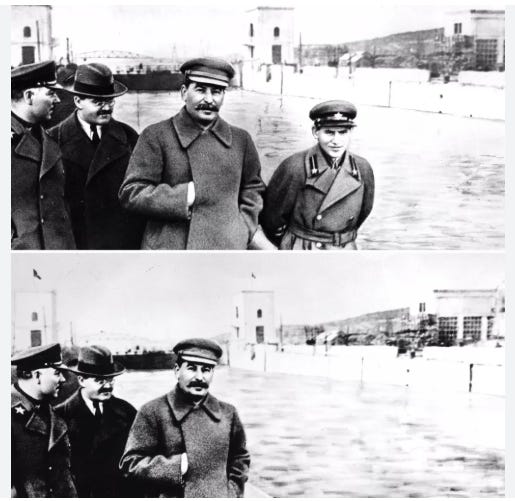
That is the sinister version of Memento.
Leonard, the character in Memento, leaves himself evidence because he cannot trust his memory. A regime alters the evidence because it wants everyone else to distrust theirs.
Most of us live somewhere much less dramatic between those two extremes. But the principle is useful.
So perhaps Ted Gioia has the right idea.
Go on eBay and buy some history.
Buy the hundred-trillion-dollar Zimbabwe note and put it in a Romance novel. A child who finds it twenty years from now may ask how a country managed to print a banknote with that many zeroes on it. Buy an old newspaper from a day everyone once thought would change the world, or didn’t. Keep a few photographs outside the cloud. Save something from your parents and grandparents and, more importantly, write down what it means.
Don’t merely collect old stuff. Give yourself evidence.
Investors should probably do this too. Markets have a remarkable ability to make the current environment feel permanent. During every mania there are intelligent explanations for why prices must keep rising. During every panic there are intelligent explanations for why they can never recover. An old stock certificate, failed currency, annual report, newspaper headline, or piece of obsolete technology is a useful reminder that people before us were just as certain about their present as we are about ours.
The point isn’t nostalgia.
Those who don’t know history may be doomed to repeat it. And for those who do know it aren’t guaranteed anything either, but perhaps they can recognize the disaster a little earlier.
And there is another reason to do it.
One day your children or grandchildren may wonder what the world looked like while you were here. Don’t make them depend entirely upon an algorithm to tell them.
Leave a few clues around the house. B
READCRUMBS!
Not just on your phone but honest to God mementos of family, life, culture and history.
Don’t take my word from it but Academy Award winning Christopher Nolan whose first film was where a man has mementos to know who he is.
Make it a Wonderful Wednesday,
Eric
PS. For subscribers, we will review an opportunity I see later in the day.
The part about leaving physical evidence behind for your kids and grandkids stuck with me. A camera roll isn’t the same thing as finding something in a drawer 30 years later.