

Out of the Box Thinking
Japanese startup is making drones out of corrugated cardboard.

History has seen this before.
The market hasn’t priced it yet.
I was reading a piece from Japan this week. Defense Minister Shinjiro Koizumi had just met with a startup called Air Kamui and posted about it on X like a proud dad whose kid finally built something useful with the Amazon boxes.
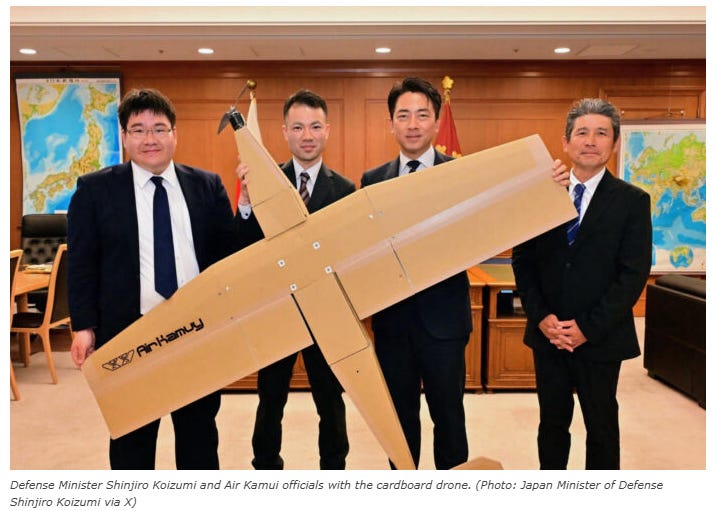
The Japan Maritime Self-Defense Force is already using their product in live exercises.
The product is a drone made of corrugated cardboard.
Flies at 120 kilometers per hour. Two hours of flight time. Assembles in five minutes from a flat-packed kit. Costs $2,500, roughly one-tenth the price of a conventional fixed-wing unmanned system.
I read it twice.
Then I started thinking about wood.
The Devolution Principle
There is a pattern in the history of weapons that runs counter to everything we assume about progress. We think sophistication only moves in one direction: more sensors, more propulsion, more everything. And it does.
But alongside that vertical ascent, there is always a horizontal devolution. The material gets simpler. The production gets distributed. The cost collapses. And something interesting happens to radar visibility.
The Germans understood this in 1944. The Horten Ho 229 was a flying wing built substantially from wood, not because the Luftwaffe couldn’t access metal, but because wood absorbed radar waves rather than returning them.
Radar? Never heard of her.

The British de Havilland Mosquito was the same logic. Called “The Wooden Wonder. ” Built from birch plywood and balsa. It was faster than the fighters sent to intercept it, not despite the wood, but in some measure because of it. The Germans were not amused.

Fast forward to 2024. Russia deploys the Molniya, a fixed-wing strike drone built from plywood and aluminum, assembled somewhere by someone who understood that physics doesn’t care about your materials budget. Range of 30 kilometers. Used intensively over Kherson. Precise enough to matter.
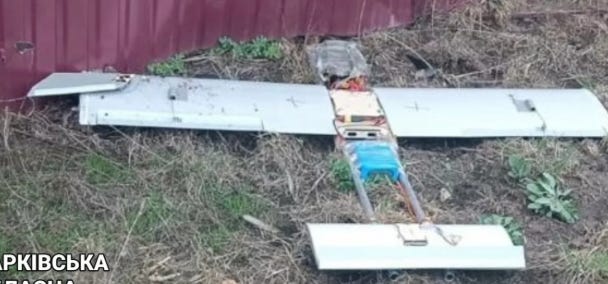
The pattern isn’t primitive thinking. It’s refinement. Each generation strips away what isn’t load-bearing and keeps what works. What keeps working, decade after decade, is the basic physics of non-metallic materials: they don’t return radar signals.
What Cardboard Does That Carbon Fiber Can’t
Radar cross-section measures how much electromagnetic energy an object reflects back to the receiver. Metal reflects well. Carbon fiber reflects somewhat. Corrugated cardboard reflects essentially nothing.
The Air Kamui drone is currently classified as a training target, something for naval gunnery crews to shoot at during missile defense exercises.
That framing is deliberately modest. The same brief that describes the training application describes a second use: reconnaissance.
A platform that flies for two hours and doesn’t appear on radar is not just a target drone. It is a persistent surveillance asset that, to the defense grid, appears like weather.
In April of this year, a Japanese startup called JISDA presented the ACM-01 Shiraha wooden fuselage, with an estimated unit cost of $450, built entirely from locally sourced components. Four hundred and fifty dollars.
I’ve spent more on a dinner I don’t remember.
This is not a niche curiosity. This is the direction.
Nothing says intrinsic value like the humble box that once held your overpriced protein powder.
When a commodity gains a defense application, it doesn’t just gain a new customer. It gains a specification.
Specifications create moats.
The moment a DoD procurement desk writes corrugated composite airframe into an approved materials list, the suppliers of that material stop being packaging companies and become defense contractors. That is not a metaphor. That is how the multiple expands.
Kevlar was a DuPont textile fiber before it was body armor.
Aluminum was a luxury metal more expensive than gold in the 1850s before it became the backbone of aerospace.
Carbon fiber was an industrial curiosity before it became a defense procurement line item.
In each case, the transition was invisible until it wasn’t, and the commodity producer got a rerating that had nothing to do with their existing customer base.
The question is always the same: are you there before the specification, or after?
The Box Barons
Three publicly traded companies dominate corrugated containerboard in the United States. All three are currently valued as if they will spend eternity fighting for Amazon’s returns business.
International Paper (IP) is the largest U.S. corrugated producer by volume, integrated from pulp mills through finished product. The most direct pure-play on the commodity itself.
Smurfit Westrock (SW) was formed from the 2024 merger of WestRock and Smurfit Kappa, now the world’s largest corrugated packaging firm by revenue. Global footprint that includes Asia, where this particular madness is currently brewing.
Packaging Corporation of America (PKG) has the cleanest balance sheet and the best margins of the three. The quiet one.
Right now, nobody is pricing in the upside of “our boxes now fly military missions.”
I don’t know if you can price it in really, as I’m imagining a future of “growth” in cardboard
The industry grew 1.8% in 2025. These are not exciting stocks. That is precisely the point.
All it takes is one boring government document: approved airframe material.
Before that document exists, this is a narrative.
After it exists, it is a rerating. Consider what else would need to be true for that document to appear.
NATO allies have committed to 2–3% of GDP on defense, with drone procurement as a stated priority.
The FCC’s implementation of the FY25 NDAA drone ban removes foreign-manufactured unmanned systems from the U.S. market, creating a structural demand for domestically sourced, NDAA-compliant alternatives.
A corrugated airframe made from 100% domestic recycled fiber, assembled in one of the 2,100 box plants distributed across the American interior, fits precisely inside that procurement logic.
The biodegradable angle isn’t incidental. A cardboard drone leaves no recoverable wreckage. No metal signature. No persistent debris. No serial numbers. No intelligence value upon recovery, just soggy pulp and a disappointed adversary. That is not a cost-saving feature.
That is a tactical feature. Militaries pay premiums for tactical features.
And you cannot bomb your way out of a supply chain built on corrugated cardboard.
There is a box plant within 150 miles of nearly every American city. That is distributed resilience that no carbon fiber manufacturer can match.
The most dangerous weapons are usually the simplest ones. Not because simplicity is inherently powerful, but because simplicity is invisible. It doesn’t register in the adversary’s defense calculus. It doesn’t show up on radar. It doesn’t look like a threat until the engagement is already underway.
A Japanese startup is turning the same material that protects your Funko Pops into a military asset used by the Navy for live-fire exercises.
International Paper. Smurfit Westrock. Packaging Corporation of America.
If history rhymes the way it usually does, one day they will be neither cheap nor unloved. The upstream logic is already in motion. The market just hasn’t looked upstream yet.
If you gained any insight, subscribe . Lots in store for my loyal readers.
Don’t have a wonderful Friday, make it so
Eric
Do you have a link to that Article, I'd love to read into it more?