

The Benjamin Graham book that only the Chinese read
Launching a Book Club with the one Book that is Important for 2026 but published in 1944

I think most people are starting to sense that we’re no longer living in the post-WWII or Cold War world, even if they can’t quite articulate what replaced it.
You can see it in the surge of Substack readers, the endless scrolling through wildly divergent viewpoints, the sense that some framework must exist to explain why everything feels unstable, yet nothing looks obviously broken.
And yet, there is nothing new under the sun.
As Warren Buffett fades into the sunset, his investing legacy resting comfortably beside his mentor Benjamin Graham, there’s a side of Graham almost no one talks about.
Even Vic Niederhoffer didn’t touch it.
It’s Graham’s commodity side.
The side that makes people uncomfortable.
The side that doesn’t fit neatly into stock screens or valuation spreadsheets.
The side that, judging by behavior rather than citations, may have been more deeply absorbed by China than by Wall Street.
The book begins with the word China.
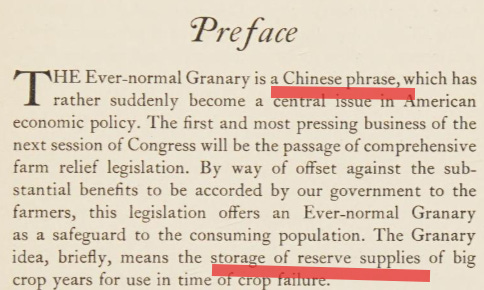
Three years after the legendary Security Analysis, Graham wrote a much smaller, largely ignored work: Storage and Stability (1937), followed by its wartime addendum World Commodities and World Currency (1944).
Together, these essays describe the world we’re living in now — but from an angle no one seems to be using.
Example: Everyone is arguing about the dollar.
It sounds like people fighting over deck chairs.
Who should sit where?
Who deserves the window?
Who’s being treated unfairly by the waitstaff?
Graham noticed the problem before most people realized they were playing the wrong game. I think most people are realizing we are past the post-WWII era and Cold War era, and now in uncertain times for at least those living and trying ever so hard to get a grasp by joining Substack and reading so many divergent views.
Not the Benjamin Graham of margin of safety and cigar butts. The other one. The one I just highlighted and quietly ignored because it makes everyone uncomfortable.
In World Commodities and World Currency, Graham wasn’t debating whether fiat currency works.
That’s a childish question.
He was asking something much darker and much more adult:
What happens when money is no longer restrained by anything that humans can’t manipulate?
This is where modern discussions immediately fall apart.
The Villain (Every Story Needs One)
The villain isn’t inflation. It isn’t deficits. It isn’t even money printing.
The villain is the belief that smart people can be trusted with unlimited discretion.
Graham didn’t hate governments. He didn’t worship gold. He didn’t predict collapse for sport.
He understood incentives.
And incentives, when unanchored, drift.
Always.
Graham, Translated Into Plain English
Here is Graham’s argument without academic makeup:
If money is anchored to nothing external, it becomes a political instrument. If it becomes a political instrument, it will be used politically. If it’s used politically, it will eventually be abused.
Not because people are evil. Because they’re human.
Especially the well-intentioned ones.
This is the part people skip because it ruins dinner conversations.
Why This Matters Right Now (And Why You’re Watching It Happen)
While everyone debates whether currencies are strong or weak, look at what’s actually moving:
Oil went from $70 to $130 and back to $70. Not over decades. Over months. Cotton doubled. Copper swung 40%. Wheat became geopolitical ammunition.
Bitcoin went from $15,000 to $69,000 to $16,000 to $100,000. Each cycle, more institutions. More legitimacy. More “maybe this is actually the thing.”
Meanwhile, EUR/USD moved 15% and people wrote thinkpieces about dollar dominance.
Notice the pattern?
The currencies look stable. The things you can buy with currencies are violently unstable. And the things people are inventing to escape currencies are becoming systemically important.
This is exactly what Graham predicted would happen when money loses external restraint.
The instability doesn’t show up where you’re watching. It shows up in what money is supposed to measure.
The Arguments That Prove No One Understands This
The MMT crowd says: “Deficits don’t matter because we print our own currency.”
The deficit hawks say: “Deficits will destroy us through inflation and collapse.”
The crypto maximalists say: “Fiat is dying, math is the only anchor.”
The gold bugs say: “Return to sound money or perish.”
Graham would recognize all of these as denominator arguments.
They’re fighting about what money should be backed by. He was asking what happens to human behavior when backing becomes optional.
That’s not the same conversation.
The BRICS nations aren’t trying to destroy the dollar because they read Austrian economics. They’re doing it because they’ve watched the U.S. use currency access as a weapon and decided discretion cuts both ways.
That’s not a monetary debate. That’s a Graham debate.
What Graham Saw That Everyone Else Missed
Graham wrote World Commodities and World Currency in 1944, right as Bretton Woods was being designed.
He didn’t predict Bretton Woods would fail. He predicted why it would fail.
Not the mechanism. The incentive structure.
He proposed anchoring currency to a commodity basket—not because commodities are magic, but because they’re external. No committee votes on whether copper exists. No central bank can print soybeans.
The proposal was ignored.
Instead, we got gold until it was inconvenient (1971), then “faith and credit,” which is another way of saying “trust us, we’re professionals.”
Here’s what happened next:
1970s: Stagflation that wasn’t supposed to be possible under Keynesian models
1980s: Volcker had to inflict a recession to restore credibility after a decade of discretionary failure
1990s: “Great Moderation” where everyone congratulated themselves for solving economics
2000s: Housing bubble built on the assumption that discretion had been perfected
2008: System saved by discretionary intervention that became permanent
2020: Discretion deployed at scales that would’ve seemed fictional in 2019
Each cycle, the discretion expands. Each cycle, someone says “this time we’ve learned.” Each cycle, Graham’s question gets louder:
What restrains the restrainers?
Where People Get This Wrong
Gold bugs think Graham was predicting a return to metal. Crypto maxis think he was predicting math-based money. Economists think he was solving equations.
He wasn’t.
He was diagnosing human behavior under weak constraints.
The form doesn’t matter as much as the restraint.
That’s the uncomfortable part.
A gold standard run by people who can change the rules isn’t a gold standard. It’s theater with props.
A fiat system run by disciplined technocrats who never face emergencies might work forever. But emergencies are the test. And discretion always wins during emergencies.
Graham understood this because he watched it happen in the 1930s.
We’re watching it happen again. We just don’t call it the same thing.
The Investor Takeaway (Calm, Not Tactical)
This isn’t about collapse. It’s about surprise.
People lose money not because systems fail overnight, but because they assume systems are more disciplined than the humans running them.
Graham wasn’t telling you to bet against the world. He was telling you not to trust it blindly.
Big difference.
The portfolio implication isn’t “buy gold” or “buy Bitcoin” or “short the dollar.”
It’s diversify by anchor type, not just by asset class.
Some of your wealth should be in things anchored by law and institutions (bonds, cash, stocks).
Some should be in things anchored by physics (commodities, real assets, energy).
Some should be in things anchored by mathematics or scarcity (Bitcoin, maybe other crypto if you’re feeling adventurous).
Not because any one will “win.” Because Graham’s insight is that all human-managed anchors eventually drift, and you want to be holding things that drift in different directions.
When currencies look stable but commodities are thrashing and crypto is becoming systemically relevant, you’re not watching chaos.
You’re watching anchor-shopping in real time.
Why You Should Join This Book Club
Here’s what you won’t get:
No gold bug manifestos
No crypto evangelism
No collapse porn
No political tribalism
No one trying to sell you a newsletter with “the one weird trick Central Banks don’t want you to know”
Here’s what you will get:
A group of people who are tired of having the wrong argument. Investors who think policy matters more than charts. Operators who need to understand currency risk but don’t want to get a PhD in monetary theory. People who’ve noticed that Bitcoin hit $100k while the dollar “stayed strong” and want to know what the hell that actually means.
We’re reading Graham not because he has all the answers, but because he asked better questions than anyone else.
The format is simple:
Two pages per session (gunning for daily)
Randomness and tangents
We apply Graham’s framework to current events: What would he say about the strategic petroleum reserve being used as an inflation tool? What would he say about China’s commodity stockpiling? What would he say about El Salvador’s Bitcoin experiment?
We argue. A lot. But we argue about mechanisms, not tribes.
The time commitment: From 15 minutes to 7 hours it does not matter. What matters is trying to get one or two ideas a week from this and it will help build your investor talent stack.
The payoff: You’ll stop being surprised when currencies and Bloomberg headlines stay boring, but everything priced in currencies goes insane. You’ll understand why “sound money” debates are mostly theater. You’ll have a framework for thinking about risk that doesn’t depend on predicting which system wins.
Most importantly: You’ll be in a room with people who’ve realized the deck chair argument is boring and want to talk about the ship.
The Question Worth Arguing About
Graham asked: If currency requires an anchor, what anchors the dollar right now?
Seventy years later, here’s what we know:
It’s not gold. It’s not law. It’s not even “full faith and credit” in any meaningful sense.
It’s some unstable mix of energy dominance, military reach, network effects, institutional inertia, and the collective hope that tomorrow looks enough like yesterday.
That’s not nothing.
But it’s not immutable either.
So here’s the real question, the one Graham would ask:
When commodities become geopolitical weapons and crypto becomes systemically important and currencies stay “stable” through it all—who’s anchoring whom?
And more importantly: Who decides when it’s no longer holding?
If you think you know the answer, you don’t need this book club.
If you think the question is more interesting than any answer you’ve heard so far, [join us].
“The peculiar essence of our banking system is an unprecedented trust in the self-restraint of those with the power to create money.” — John Galbraith, 1944, a contemtporary of Graham’s
Still true. Still terrifying.
With that make 2026 a powerful year
Eric
