


As Memorial Day arrives and we pause to honor the fallen, I would like to focus your attention on the Personal Memoirs of Ulysses S. Grant, a powerful autobiography that, I would argue, begs for a great film adaptation.
Not a mini-series.
An epic movie that Christopher Nolan should follow up with from his controversial Odysseus project.
Coincidentally, just because US Grant was a Republican, don’t think for a moment he didn’t have compassion. He was very passionate about causes that gave man freedom.
So let’s begin
It starts with the name itself.
Ulysses is not an American name. It is the Latin transliteration of Odysseus.
Hiram Ulysses Grant's mom didn’t even choose it. It was his middle name.
A congressman miswrote his enrollment papers for West Point, and Grant let it stand. As if the story knew something the man didn’t yet.
The parallels only begin with the name
The Long War Away From Home.
Odysseus fought at Troy for ten years. Grant fought in Mexico during the Mexican-American War, came home briefly, then disappeared into the Civil War for four more years, bringing the total to around a decade.
Both men spent the defining years of their lives in other men’s countries, killing people they had no personal quarrel with, on behalf of something larger than themselves.
The Faithful Wife.
Penelope waited twenty years, holding off suitors, keeping the household intact through sheer loyalty.
Julia Dent Grant waited through the Mexican War, through the lonely Pacific Northwest postings where Grant drank and unraveled, through four years of Civil War.
Every biographer notes that Grant was a different, better man when Julia was present.
The Wilderness Years.
After Troy, Odysseus didn’t come straight home. Ten years of wandering through Circe, the Cyclops, the Sirens. The gods kept throwing him off course.
After the Mexican War, Grant was posted to Fort Humboldt in northern California.
Separated from Julia, he had nothing to do. He drank. Resigned his commission in disgrace in 1854.
Spent the next seven years failing at farming, failing at real estate, selling firewood on a St. Louis street corner. A forty-year-old former captain, going nowhere. The wilderness looked like the end. It was actually the preparation.
The Underestimated Man.
Fun fact: Odysseus was never the greatest warrior in the Greek camp, which was Achilles. He was something more durable: the most relentless, the one who finished what others abandoned.
Grant was never the most glamorous Union general, who was McClellan, pausing and contemplating, while his army sat still. Lincoln cycled through generals until he found one who wouldn’t stop. The one whose philosophy was “Find out where your enemy is. Get to him as soon as you can. Strike at him as hard as you can and as often as you can, and keep moving on.”
Grant didn’t win because he was brilliant. He won because he wouldn’t quit.
Even after two terms as President, he didn’t want to go off into the sunset and was aiming for a 3rd term, but his party said it was time for President Grant.
And with that, he took $25,000 and went on a world tour with his wife. The first for a President and a must if you are the reincarnation of Odysseus.
The Descent.
Every version of the Odyssey contains a katabasis
$5 word alert (I add value when I can)
Katabasis = a descent into the underworld.
Odysseus goes to Hades to gain knowledge he can’t find among the living. Grant’s descent was financial. Ferdinand Ward, his business partner, a charming fraud, wiped him out completely in 1884.
(Even happens in 2026 to legendary figures like Floyd Mayweather - let’s see AI put US Grant and Mayweather in the same essay)
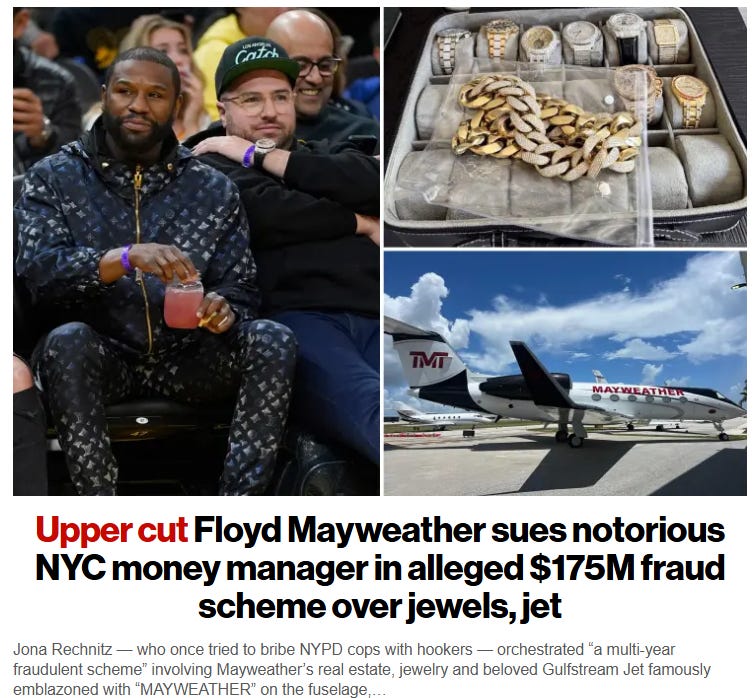
Former president.
World-famous general.
And unfortunately, broke overnight (before the presidents had pensions)
Cornelius Vanderbilt offered to pay his debts off, but US Grant, like Truman, didn’t sell the office of the White House to the highest bidder.
Then the throat cancer diagnosis. The man who had commanded armies and led the country as President for 8 years was reduced to writing in pencil, propped in a chair, racing death.
That was his underworld.
And like Odysseus, he came back from it with something, his Memoirs. The one thing that would protect his family after he was gone.
The Impossible Final Act.
Odysseus returns to Ithaca disguised as a beggar and strings a bow no suitor could bend: proving in one motion who he was and reclaiming everything taken from him.
Grant finished his manuscript four days before he died. He had promised his publisher a complete book. He kept the promise. In longhand.
The Memoirs sold 300,000 copies. Julia received the equivalent of $15 million. The general’s last act was his greatest act of provision and a memorial for all those who helped shape the US in the Civil War.
But Here Is Where the Myth Ends and the Man Begins
Odysseus is literature. Magnificent, enduring, true in the way only archetypes can be true, but he never existed. His journey was personal.
Get home.
Reclaim Penelope.
Kill the suitors (I guess it was easier back then).
The story ends with a bloodbath, like a classic shootout in a film.
The suitors’ families come for revenge. Ithaca is on the brink of civil war. Athena herself descends from Olympus to broker a ceasefire. The hero came home and nearly tore his own kingdom apart in the process.
Grant ended his war differently. He was a man of peace.
Appomattox, April 9, 1865. Lee surrendered.
Grant could have demanded humiliation, as the Treaty of Versailles did to end World War 1 (we saw what happened afterward).
Grant let them go home with their horses.
He told his men not to cheer when the surrender was announced.
“The war is over. The rebels are our countrymen again.”
That single decision is why there was no Confederate guerrilla insurgency.
Then, as president, he did something almost nobody credits him for: he prosecuted the Ku Klux Klan under the Enforcement Acts, deployed federal troops to protect Black voters, and broke the Klan’s first iteration.
The 15th Amendment, the right to vote regardless of race, became law on his watch. He didn’t just win the war. He tried, imperfectly and against enormous resistance, to win the peace.
Odysseus was trying to get back to his life. Grant was trying to save everyone else’s.
The myth ends with one man reclaiming his house. The fact ends with four million people free and a country, barely, held together.
That’s not mythology. That’s history. And history is harder.
Oh, wait, there is a writer involved. The greatest one of the 19th century.
The Twain Partnership
And one of the Greatest Marketing Operations in American History
Mark Twain wasn’t just Grant’s friend. He was the most famous writer in America. And when he saw his friend being offered 10% royalties for his soon to be written autobiography, he intervened.
Twain created his own publishing house specifically to handle the Memoirs and gave Grant 70% of the net proceeds.
It would outsell Adventures of Huckleberry Finn.
The distribution machine Twain built was extraordinary.
Ten thousand agents, many of them Union veterans in their old uniforms, canvassed the North with a pitch Twain had scripted himself. Two volumes, priced from $3.50 to $12 depending on binding.
The timing was brutal and perfect: Grant died days after finishing the final page, and Twain turned the national mourning into the largest subscription book sale the country had ever seen.
Grant’s prose is spare, direct, entirely without self-pity. He describes battles the way a good trader describes a position: what he knew, what he didn’t know, what he decided, and why.
No heroism inflation.
No score-settling.
He writes about the Mexican-American War as one he considered unjust, but fought it anyway, learned from it, and never pretended otherwise.
The lesson beneath it all is simple: finish the work
Grant finished his book in pencil, barely able to speak, because the work mattered and the people depending on him mattered.
The least we can do is stay sharp.
With many things going on in the world, I hope some of what I shared today puts things into perspective.
To dig deeper, Subscribe today
Great comparison. They’ll never make a movie about him, and that’s for the best.
Chernow’s biography is a great read, and I enjoyed the miniseries ‘Grant’. Definitely a figure worth studying and learning from.