

We have reached a TOP
But it's not the market that you are watching

The great value proposition of reading me is that I try to be optimistic. Not performatively optimistic. Not the kind that requires you to ignore the news. The kind that comes from looking at the actual data and saying: We are in one of the greatest bull markets in history.
And the markets are at all-time highs. With a stubborn Fed. A stubborn Iran. A stubborn political and media class that has made a career out of telling you the ceiling is about to cave in.
I’ve argued repeatedly that this market is strong.
You don’t want to be too negative on US government policy and the financial markets attached to it. These are not fringe views. They are the exact views the billionaires use to mint money. If my perspective were wrong, it wouldn’t keep working.
Let’s be honest: if you are an investor right now, it is nearly impossible that you are losing money. But I know what you’re thinking. Bubble. You’re watching your portfolio, hand on the exit door, ready to close it all out.
No one makes money with one foot out the door.
So today I’m going to do you a favor and be pessimistic about something specific. Something that has been the organizing principle of our entire adult lives.
I’m calling a generational top.
In BS.
We have just lived through the greatest century of institutionalized, industrialized, policy-driven, media-amplified, credentialed-expert-approved BS in recorded history.
And the top is in.
You name it, we tried it.
None of it worked the way they said it would. All of it made someone at the top of the food chain very rich.
What in tarnation is going on?
Need some proof?
Last week, Hank Paulson, the Treasury Secretary under George W. Bush, the man who presided over the 2008 market crash and Great Recession, who let Lehman die while giving Goldman Sachs the runway to go from $80 to $1,000 a share, came out of the woodwork.
Or rather, the press dutifully echoed his current thoughts.
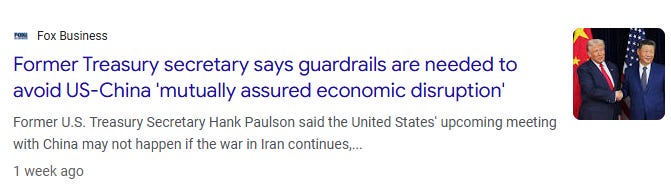
Paulson is warning about US-China “mutually assured economic disruption.” Which is a fascinating thing to hear from the man who slept through the subprime disaster and sank the economy into oblivion, but walked away with his Goldman shares intact.
The establishment trotting out Paulson as a credible voice on economic risk is Exhibit A in the case I’m making.
Funny how when the US is reasserting its superpower role, securing the free world from unproven and impractical ideology, we’re suddenly supposed to be terrified of China again.

Then Jensen Huang, who not only invented the AI super chip (and I suspect Bitcoin, but I digress), is also the most prominent voice predicting that half of humanity will be automated out of work, weighs in on the geopolitical semiconductor rivalry.
His point isn’t wrong. Chinese developers are formidable. But here’s the key distinction nobody wants to make: the preponderance of Chinese AI development is oriented toward surveillance and social control. Facial recognition at scale. Predictive policing. Credit scoring tied to political behavior. That is not the same thing as building economic tools for growth and open markets. The engineering talent is real. The mission is different.
And mission determines outcome.
I heard the same breathless warnings about the Soviets. They had rockets. They had engineers. They had hard workers. We know how that ended.
The media’s track record on this stuff is not good. The same outlets that catastrophized everything the current administration did are now your guides on global economic risk?
That’s why Substack exists. That’s why you’re here.
And I’m sharing my thoughts with you, dear reader.
So here’s where I land:
How many times did we hear the crash was around the corner? How many times did the permabears get airtime while the market quietly put in new highs? Even the tech survivors from the 90s, SanDisk and Qualcomm, are making great strides. These are multi-billion-dollar institutions.
They don’t jump on a $500 speculative bet.
They move on large institutional money flows.
There are only two explanations for what we’re watching.
A bubble. Or true economic demand.
Our entire generation has been conditioned to see bubbles. We graduated into the dot-com crash. We bought houses into 2008. We watched Crypto Mania twice. Every expansion has ended in carnage, so we’ve pattern-matched ourselves into permanent skepticism.
But consider: the markets in the early 80s, before the 1987 crash, were also phenomenal. Reagan deregulated, cut taxes, and let business breathe. The market responded with one of the great bull runs in history. Was it a bubble? Parts of it. Did it matter in the long run? Not much. The Dow was at 776 in 1982.
Where did it go from there?
An open society that gives capital and business room to expand will always find a way to produce wealth. Always.
Here’s the deeper read on what’s actually happening.
Today, the US Dollar declined, and I’ve been thinking hard about what Bessent and Trump actually need to pull off. The theory is ambitious: reassert American economic supremacy, attract foreign capital at scale, and restructure global trade relationships in America’s favor.
To do that, you don’t just need strong equity markets. You need capital flowing into this country, and capital flows to where it is treated well, where the rule of law holds, and where returns are real.
A strong dollar becomes a paradox: it makes dollar-denominated assets more expensive for foreign buyers, but it also signals confidence, and confidence is the ultimate magnet.
The dollar move today was a data point, not a verdict. Watch the capital flows. That’s the real scoreboard.
If the theory is correct, and I wrote about this before, Tesla is a useful barometer.
Not because of the cars. Because Tesla requires optimism about the future to hold any valuation. It is priced for a world where things work out. When Tesla is rising, people believe in something.
That belief has to be grounded somewhere real, in an expanding economy that can absorb the growth.
And now, my mic drop.
Premise: AI is the most ambitious attempt in human history to quantify, systematize, and automate all accumulated human knowledge.
Trillions of dollars are flowing into it.
If the underlying data those systems train on is corrupt
full of spin, manipulation, propaganda, and institutional BS
the AI won’t work. Garbage in, garbage out. That’s not opinion, that’s engineering.
So here is the conclusion that no one is drawing out loud:
As AI rises, BS falls.
Not because AI is moral. Not because the people building it are saints. But because the entire enterprise requires accuracy to function.
That is the real Skynet.
Truth and the American way.
You cannot build a working intelligence on a foundation of institutionalized misrepresentation. The machine will fail, and everyone will know it. The incentive structure, for perhaps the first time in a century, points toward truth.
The greatest bull market isn’t just in equities.
It’s in reality.
Have a great evening.
— Eric