


Today’s piece is a little longer. But I did try to delve deep in the meaning of time, at least for me.
Enjoy.
I always had a knack for investing, but not trading. It took me years to understand the difference, and longer still to understand that the difference was really about time: who controls it, who’s pretending to.
Film enthusiast, Dave Bongiorno said something to me once that I haven’t been able to shake. He said you don’t need to watch the whole movie.
Who has the time?
But that’s the point. He meant it as a kind of efficiency as you know how it ends, you know the beats, why sit through all of it.
I think he is wrong, and I think the reason he is wrong is the whole subject of this essay.
Because the movie is not the plot. The plot is what’s left over after you remove the two hours. What you actually paid for, what you sat in the dark for, was the two hours: the part everyone is now in such a hurry to cut out. As he quipped today:
We do this with everything now. We summarize, we abbreviate, we skip to the end, and we call it efficient, and what we have actually done is remove the only part that was any good. There is no joy in a synopsis. There was never going to be.
Joy doesn’t live in the conclusion. It lives in the duration, and we have spent twenty years building machines whose entire purpose is to get you to the conclusion faster, and we are surprised that nothing feels like anything anymore.
I think about this every time I look at a stock chart, which is a strange place for the thought to live, but there it is.
A few months before the 2008 crash, I kept shorting the market. I had good information and I’d done the work, I believed the thesis but I kept losing, week after week, until I had to stop trading entirely, and of course the market cratered about six weeks after I gave up. I complained about this for years afterward, the way you do, and my boss finally told me, “Eric, it’s all about timing.”
I fought that sentence for a long time because it felt like an excuse dressed up as wisdom. His boss owned one of the largest mansions in Florida, so I suppose somebody was timing things correctly. I was not the one to argue.
But I don’t think it was about timing, not the way he meant it. I think I was trying to do to the market what Bongiorno does to a movie: skip to the part where I’m right, without sitting through the part where the market hadn’t decided yet.
The crash was coming. I just couldn’t make it come on my schedule, and the market, like a film, does not move at the speed of your certainty. It moves at its own speed, and your only choice is whether you sit through that or not.
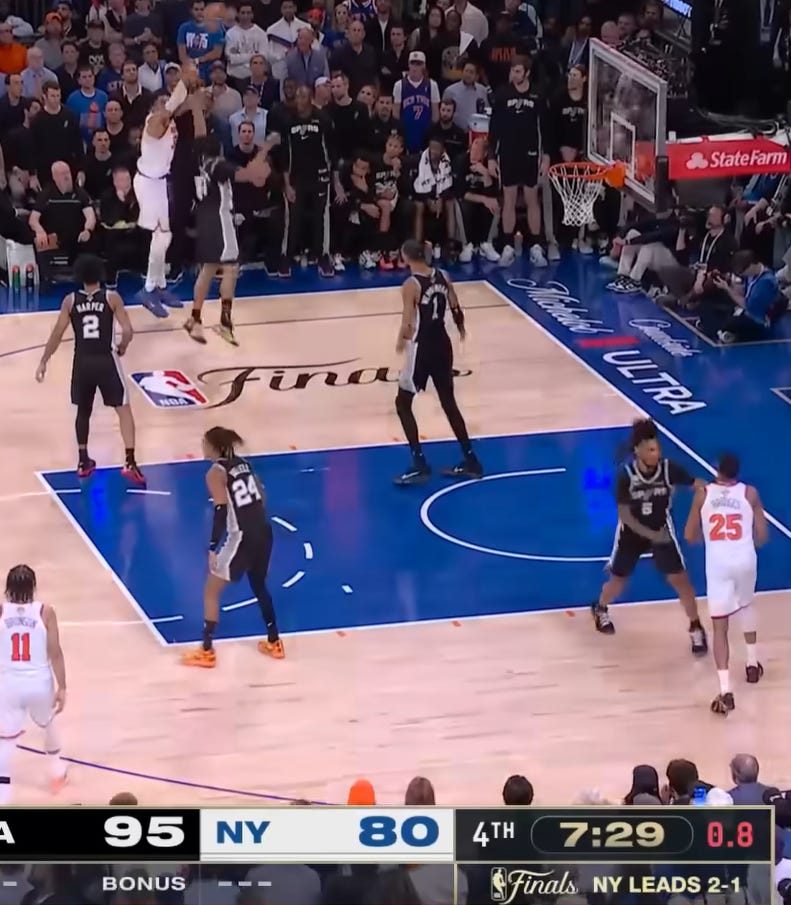
I think about 7:29 left in the fourth with the Spurs in a dominant position. If you stopped the broadcast there you would know exactly how it ends.
Except you wouldn’t, because the part where it actually ends had not happened yet, and what happened in those 7:29 minutes is the entire reason anyone still talks about that series.
The lead was real. The outcome was not yet decided. Those are different facts and we keep treating them as the same fact.
This, I think, is the case for owning a stock the way you’d own a piece of memorabilia rather than a chip you’re trying to flip before the buzzer. A Funko Pop gathers dust on a shelf and you tell yourself it’s worthless right up until, decades later, someone wants exactly that one. Nobody is charging you rent on the shelf. Nobody is calling your loan. The stock certificate does the same thing, quietly, in your brokerage account, while you go on with your life and this, as far as I can tell, is the only form of investment where you are actually allowed to control the time instead of the time controlling you.
There is a second thing hiding inside all this, which took me longer to see, and it is this: time spent is not just tolerated by value, it is what creates it.
We talk about patience as if it’s merely the absence of interference: you wait, you don’t disturb the thing, and value accrues on its own, like a Funko Pop quietly aging on a shelf. But that’s not quite right either. The waiting isn’t passive. The hours themselves are doing something.
My son will tell you he has put in over a hundred hours on a One Piece game on the PS5, and he will tell you this the way other generations announced a varsity letter or a black belt. He is proud of the hours, not just the outcome. And I used to think this was a kid thing, a generational quirk, until I realized it’s actually the oldest economic truth there is, just relearned by people too young to have known it was lost.
Social media spent fifteen years training us that value comes from the take: the clip, the highlight, the summary and hid from us, deliberately or not, that value actually comes from the put-in.
The hundred hours is not the cost of getting somewhere. The hundred hours is the thing itself.
This is why I think Disney has a harder decade coming than people expect, and it isn’t really about movies at all. Disney’s whole machine used to run in one direction: make the film, build the character, and the character’s accumulated meaning, all those hours audiences spent with him, across years, across sequels, is what justified the theme park, the toy, the lunchbox. The character had to earn the park.
Comcast, oddly, has the more honest model right now, because Universal doesn’t insist its characters were born in-house; it borrows whoever already has the hours logged with an audience, wherever those hours came from, and builds the ride second. The ride was never the point. The ride is just where you go to spend a little more time with something you already gave a hundred hours to.
And the toy companies and the game studios understood this before the studios did. Nobody builds a following by starting with the theme park. You start with the thing people return to → the toy they keep on a shelf, the game they put a hundred hours into, the figure they trade with a friend.
The following comes from the accumulated time spent with that character, not from the spectacle built around him afterward. Entertainment worked when you could relate to a character, which is just another way of saying: when you’d spent enough time with him that he started to feel like he was yours.
It is the same with stocks, and I don’t think this is a metaphor so much as the same mechanism wearing a different name. You don’t really own a company because your account shows shares. You own it the way you own a character by the hours you put into knowing it, watching it, sitting through its bad quarters the way you’d sit through the slow part of a film, until eventually you relate to it the way you’d relate to someone you’ve actually spent time with.
Why do you think the big corporations blast their logo everywhere and show up to an interview at any given time?
It was never about the plot and getting down to it. It’s the adventure and the journey.
Enjoy yours today
Eric