


Today, I discuss the most visible news event that you haven’t considered and how a CIA analyst hired by a hedge fund would parse it.
It’s not a stock idea article but one to be aware of and think about…
There used to be a time in Boca Raton, Florida, when there was a hurricane discount if you had ever tried to buy a condo in Boca.
There’s always a ceiling on what the market will pay because somewhere in the back of every buyer’s mind sits the possibility that a Category 4 comes through, along with CNN and Anderson Cooper showing charts that the entire state will be submerged in water.
Of course, with the influx of citizens unhappy with their local politics and what their tax dollars get them, the price has bid up, with no discernible discounts for hurricanes.
South Korea has been trading with a version of that same discount for decades.
The existential dread of North Korea and an atom bomb sitting forty miles north of Seoul has always put a ceiling on what global capital was willing to pay for Korean equities.
I wrote recently about how explosive South Korea could be from here. We saw 300% in months, and that was after a crash and a presidential crisis.
Something happened this weekend in North Korea that I believe is very important and very overlooked.
And could help portend the success of the current White House’s agenda, its upcoming meeting in China, and the great potential in South Korea (and North).
Plus a few historical nuggets you may not have considered.
Realize that Kim Jong Un has watched recently as Trump plans his state visit to China:
Venezuela had a forced regime change
Iran totally obliterated
Russia and Ukraine are close to reconciling
Cuba being embargoed
Politicians, like Karen Bass, closely aligned with Cuba and communism are coming under heavy scrutiny
So he did what any sane leader would do to ensure his survival: he announced an automatic nuclear launch protocol known as the dead man’s switch.
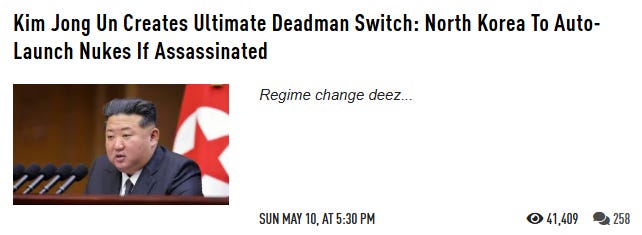
.ie if leadership is eliminated, the missiles fly without anyone having to give the order.
What most people will hear: escalation.
Here’s what a cold-blooded analyst reads: deterrence doctrine.
In the not-so-distant past, Europe also had this existential dread in the form of East Germany.
East Germany wasn’t really a country.
It was a buffer state for the USSR. The moment Gorbachev quietly signaled that Moscow wouldn’t send tanks a second time, the whole thing didn’t gradually unwind. It collapsed in weeks.
At its peak, roughly one in sixty-three East Germans was an informant. But the real weapon was what the informants produced: a population that self-censored, because they couldn’t know who was watching.
The message underneath all of it was the same message Kim is sending with the dead man’s switch:
“The system is not dependent on any single person’s loyalty. It runs itself.”
Removal of any individual piece, including leadership, didn’t stop the machine.
But it turns out the machine had always been running on one thing: the belief that it would keep running.
The moment that belief cracked, self-censorship stopped; the informants stopped informing; the border guards stopped guarding the wall; and the wall came down over the weekend.
Kim has read this case study. The dead man’s switch is his answer to it.
State announcements from Pyongyang almost never have a single audience.
The same speech does different work for different listeners simultaneously. Amateur geopolitical reading assumes the statement is literal. Professional reading asks: what behavior is this statement trying to shape, and for whom?
(I’m an amateur by the way, but thanks to AI I can punch slightly above my weight or at least I think so)
Audience One: Washington
This is the obvious read.
The message is surgical: even a decapitation strike doesn’t save you.
From a pure stability standpoint, a credible and formally announced second-strike capability is more stabilizing than an ambiguous one.
The market enjoys making drama and games over items…like a 0.25% basis cut is really going to boost the economy to the stratosphere.
Rather, the market likes clear talking points.
Audience Two: Beijing
This is the more sophisticated read, and it matters more right now than most analysts acknowledge.
North Korea fears two things with equal intensity: American military pressure and Chinese abandonment.
China today prioritizes stabilization over ideological solidarity.
When Trump sits down with Chairman Xi this week, Pyongyang watches that table very carefully.
From Pyongyang’s perspective, smaller authoritarian allies become expendable in larger geopolitical bargains. So the message to Beijing is do not trade us away.
The dead man’s switch makes North Korea harder to bargain away because the downside of instability there just got formally quantified.
This is exactly what a cornered East German Politburo member might have said to Moscow in 1987.
The difference is that East Germany had no such leverage. When Soviet protection was removed, there was nothing left to negotiate with. But it is as if East Germany did, indeed, have the bomb.
Kim has made sure that it isn’t his situation.
Audience Three: The Generals in the Room
This possibility is the most underrated and the least discussed in mainstream coverage.
The announcement may not be primarily aimed at Washington or Beijing at all.
It may be aimed at North Korea from the generals, the party officials, to the factions that might calculate that a palace coup or quiet defection becomes viable during a crisis.
The dead man’s switch solves an internal problem: it removes the incentive to remove Kim.
If the system launches automatically regardless of whether leadership survives, then taking out leadership doesn’t buy you anything.
Coup math changes entirely.
On this, the Stasi said the same thing in a different language. The system runs itself. Your individual loyalty or disloyalty is irrelevant. It worked, until it didn’t.
Historically, regimes fear the same thing: peace elsewhere frees resources for pressure on us.
This doesn’t mean Pyongyang has concluded war is imminent. It means their threat perception is elevated. And elevated threat perception produces signaling behavior.
The Boca condo analogy comes full circle here.
Cap the downside with overpriced insurance (we still have insurance, who would have thought) or a number, and suddenly the risk changes.
Kim just capped his downside with a number.
A regime that has formally committed to a doctrine, rather than leaving its responses undefined, is in some ways more predictable.
And the market prices predictability.
The ambiguity around North Korea is part of what maintains the KOSPI discount.
Not anymore.
South Korea is West Germany. More technologically advanced, more capital-rich, more institutionally capable. The companies that would participate in any peninsular integration scenario are already public and already discounted.
The question isn’t whether North Korea eventually changes. The question is what signal you’re watching for and whether you’ll recognize it when it’s subtle.
In 1989, the signal wasn’t a speech.
It was Hungary opening its border.
It was a mid-level East German party official announcing, by accident, that citizens could cross freely.
Small, ambiguous, almost bureaucratic. And then it was everything.
Watch what China does at the margins.
And any reports on border traffic. Sanctions enforcement. The tone of the state media toward Pyongyang. Energy flows. Those are your indicators.
This is one border that shouldn’t exist and it may not sooner than we think, or maybe some unimaginable thing will occur so get your popcorn.
Any North Korean and Nuke news tends to drop the market then rally hard. If a resolution in Ukraine and Iran occurs, Cuba and N Korea would be logical dominoes to focus on.
Have a great afternoon,
Eric